By Ella Hanley
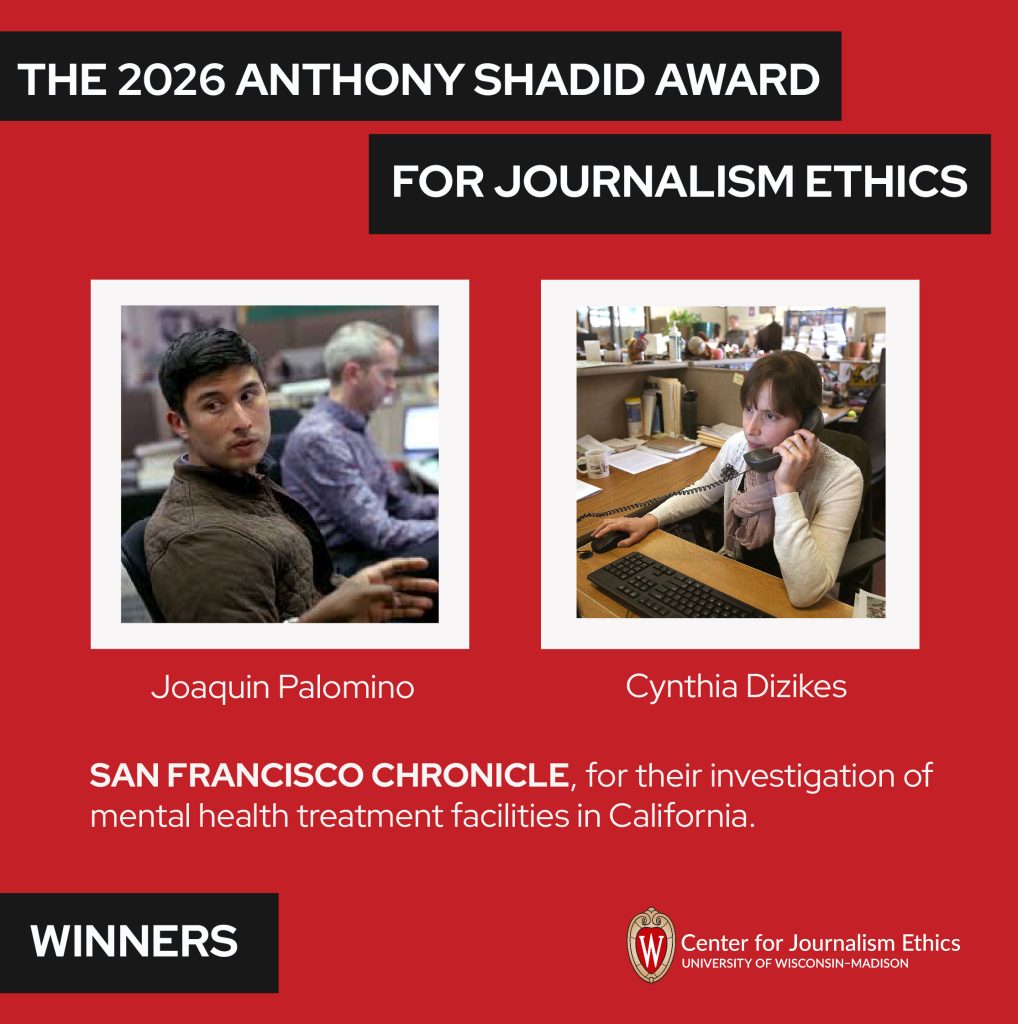
San Francisco Chronicle reporters Cynthia Dizikes and Joaquin Palomino were already deep into an investigation of California’s for-profit psychiatric hospitals when they learned of the death of 15-year-old Jazmin Pellegrini, who was found in a residential driveway.
“Her mother spoke about her significant mental health struggles and problematic care in facilities in that breaking news coverage,” Dizikes told The Center for Journalism Ethics. “That prompted us to reach out even before Jazmin’s funeral. We explained the reporting we were doing, and the story developed from there.”
The resulting article, which details how California’s mental health system failed Jazmin, is part of the four-part investigative series “Failed to Death,” which received the 2026 Anthony Shadid Award for Journalism Ethics. Over more than a year, Dizikes and Palomino investigated allegations of abuse and neglect in for-profit mental health facilities, uncovering long-standing gaps in state oversight, including a 25-year loophole in staffing requirements for psychiatric hospitals.
Following publication, Governor Gavin Newsom declared emergency staffing rules for psychiatric hospitals and directed the state health department to investigate the reported conditions. The action effectively closed the long-standing loophole that had left psychiatric facilities without mandated minimum staffing levels for decades.
Dizikes and Palomino spoke with The Center about the ethical decisions behind their reporting, how they built trust with grieving families and what it means to investigate trauma responsibly.
Where did the idea for the pitch originate? At what point did you decide it should become a series?
Joaquin Palomino: We got a tip from a former patient, from San Francisco, who had been placed on an involuntary hold and was sent to a for-profit hospital in Sacramento. He described a very horrific experience within this hospital. That was sort of what initiated the whole reporting process —- we knew nothing really about this world. We had done previous reporting on hospitals and knew of public deficiency reports, so we started looking at what the state of California had cited some of these facilities for. We immediately knew there was something worth exploring, because there were just so many horrific deficiencies.
It’s a very complicated world. We also knew the state was embarking on a massive reformation of its mental health care system, which was going to affect everything from hospitals to long-term care facilities to outpatient care. This was a big change. So we began looking at these for-profit hospitals within the context of these larger reforms.
Cynthia Dizikes: After that tip, we really just let the reporting guide us. We looked up all the deficiency reports across the facilities impacted by the changes the state is undergoing, which are at all ends of the spectrum, from acute to long-term care. We spoke to experts across that spectrum of care, and through that reporting, the acute psychiatric hospitals, specifically those operated by for-profit companies, really emerged as a facility subset with a seemingly outsized number of deficiency reports and very severe deficiency reports. We just kept chipping away at that reporting and accumulated more material. Different aspects emerged as unique stories.
How did you approach building trust with Jazmin’s mother so soon after her daughter’s death, and ensure your reporting didn’t come across as exploitative or sensational while everything was still so fresh?
Palomino: She had already been talking to the press a lot, trying to get answers about what happened to her daughter. It was also clear to us that she had a lot to share about the care her daughter received in the years before her death. We met her in person at first, and she primarily speaks Hungarian — the language she’s most comfortable with. We realized we needed an interpreter because we wanted her to fully understand the scope of our project, what we had been reporting on. We got a translator she was comfortable with, which I think was really important.
And then really it was a matter of just describing the process in depth, checking in regularly with her throughout the course of our reporting and making sure she was comfortable with having her story be told. She very much wanted to spotlight all the ways in which the system that was meant to help her daughter had failed her. We explained that this would take time, and we were in touch with her for many months. She knew that we were serious about what we were doing, and trying our hardest to tell her daughter’s story as best we could and as fully as we could.
Anytime you’re dealing with a grieving family or parent as a journalist, I think that’s the process you have to go through. You have to be sensitive and let them lead.
In reporting on other deaths in the series, you reviewed records and video footage with devastating content, including patient suicides. How did you decide what details to include and how to present them?
Dizikes: The principle we tried to guide ourselves with was if details related to the death are relevant to the failures we found, then that’s when we would communicate those details. Jazmin’s story in particular was so focused on how she had been repeatedly failed by institutions that were supposed to help her, but we also really tried to infuse each section with details from her records and from her family that spoke to her life as a child beyond her mental health struggles. We try to weave those details — when we add them, they’re in service of really underscoring the person and who they were to their family members and the people who love them.
In cases where someone died by suicide within the facilities, including the death of Tyler Thatcher Cox, we obtained surveillance video from the hospital through his family, who were supportive of incorporating the footage in some form. That prompted an internal, cross-department conversation involving Joaquin, myself, editors across the newsroom, the visuals team, and other reporters to determine what to include and why. We aimed to include only what demonstrated negligent care or reflected the conditions Tyler experienced, without being overly descriptive or including material that could increase risk for other vulnerable people. We also wanted to help readers understand Tyler as a person in that space, which was central to the visuals discussion.
Ultimately, we included a limited snippet showing him moving through the room and the proximity to the nursing station, which was relevant to the question of whether he should have been seen at that moment.
What were some of the overarching considerations that guided your reporting throughout the series?
Palomino: This project felt particularly heavy. Always keeping the families and people you’re writing about central to your reporting — they have been through immense loss and are still grieving. Being very transparent with them about the process and checking in regularly on how they’re doing. It can be really, really difficult to relive moments with them. Remembering you’re dealing with people who are willing to share these really, really difficult things and being respectful and mindful of it. I think both Cynthia and I always tried to do that on this project. It felt especially important because we were dealing with not only loss, but a lot of stigma around mental health. It’s also just a very difficult subject for both the public to read and for these individuals who have been through it. I just think the most important thing is to not forget you’re writing about real people who are dealing with unimaginable stuff.
Dizikes: To add to that, it just by necessity needs to be a slow process. I think in a lot of journalism there’s a pressure to publish news with urgency. In this case, it was imperative that we moved at a slower pace so we could have long and deep conversations with these families and give them space to think about what we had told them about the reporting process and what it’d look like. We tried very hard just to let everyone have their space and time so they could have ownership over their decisions.
How did you build trust with hesitant sources in the context of mental illness stigma, and how did you avoid pressuring those unsure about going on the record?
Dizikes: With this reporting, we really tried to reach out first through writing, whether that was email, text or letters, and we avoided cold calling. We didn’t want to risk catching someone off guard in an unexpected interpersonal interaction about something that was both traumatic and stigmatized.
More broadly, when reaching out about sensitive stories, the more transparency, the better. I think sharing the reporting process is key. Transparency evolves throughout the entire process, but being consistently open about each step of the reporting can go a long way in building trust. That means explaining what you’ve been researching, what your initial findings are, and what you think the project might become, including the level of involvement if a person or family chooses to participate. These kinds of stories require more than one conversation.
In this case, families also had to request medical records, which is a significant ask and not something everyone is willing to do or share. We tried to be very open about that upfront, explaining that we would need documentation to corroborate the reporting, while also making clear that we would work through that process alongside them.
We also found it really helpful to ask families and sources how often they wanted to stay in touch. Some people wanted much more regular communication, and some did not. We tried, and kept track of that throughout months of reporting. As Joaquin mentioned before, we really tried to prioritize those relationships and meet people where they wanted to be met in terms of being brought along in the process.
How do you manage the emotional toll of reporting on traumatic subject matter while still doing the work?
Dizikes: It doesn’t have to be a big project — whenever anyone chooses to share their grief or the worst moments of their lives with us, it is our responsibility to be the best reporters we can be, and to bring our best to that conversation. And I think everyone is different, reporters included, in how they process things and how much time and space they need to give themselves. So I just think as reporters, you need to be really conscious about what you need to do to take care of yourself so you can bring your best to those conversations.
Palomino: The whole thing was very hard…I think the way Cynthia put it is important. Remembering that as hard as it is for us, it is infinitely harder for the person who is choosing to sit with you and tell you their story. Keeping that in mind, and trying to honor that responsibility to them in the moment, can be grounding.
Ella Hanley is a 2025-26 fellow at the Center for Journalism Ethics and a senior in the School of Journalism and Mass Communication at the University of Wisconsin–Madison.
The Center for Journalism Ethics encourages the highest standards in journalism ethics worldwide. We foster vigorous debate about ethical practices in journalism and provide a resource for producers, consumers and students of journalism.