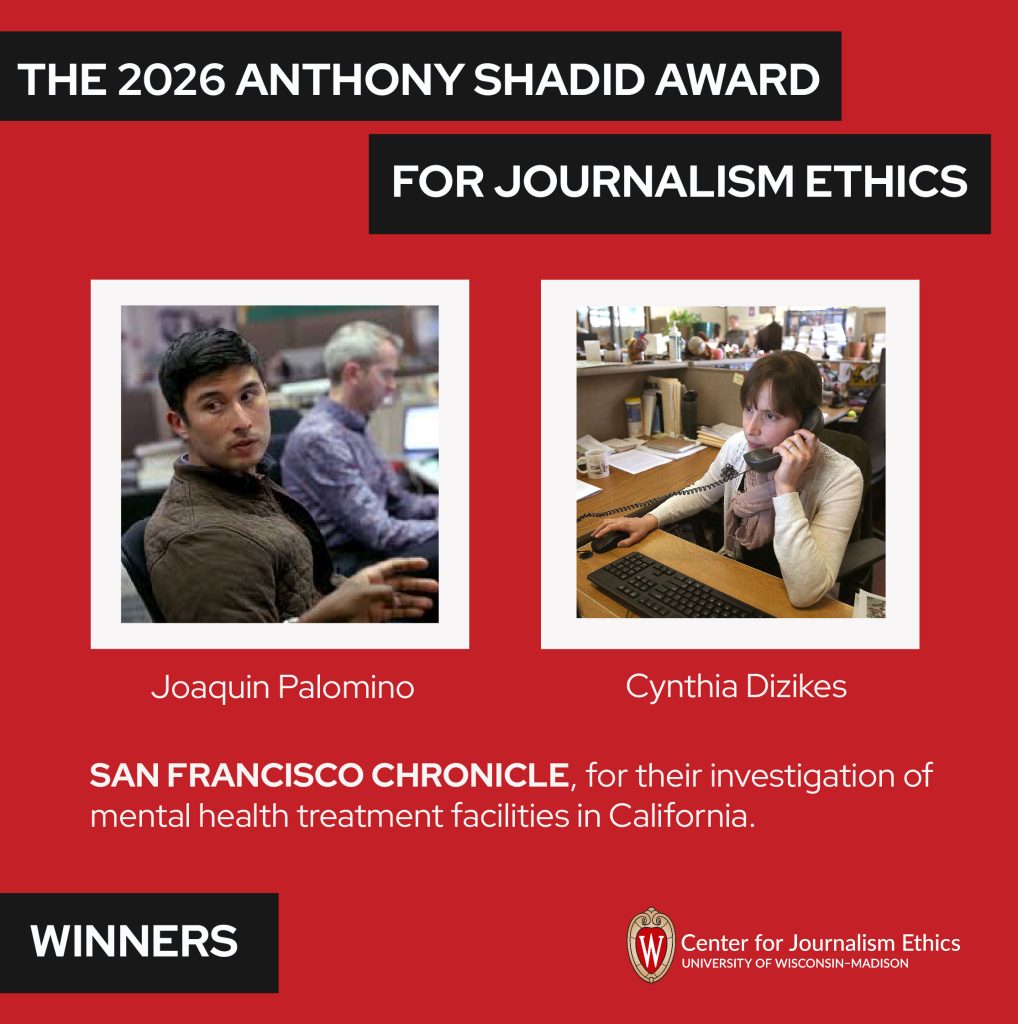
The San Francisco Chronicle’s exposé of neglect and violence in California’s behavioral health care system has won the 2026 Anthony Shadid Award for Journalism Ethics.
Two reporters from the San Francisco Chronicle have won the 2026 Anthony Shadid Award for Journalism Ethics for a four-part investigation showing how California’s haste to open more behavioral health treatment facilities led to widespread violence and neglect.
Joaquin Palomino and Cynthia Dizikes spent more than a year pulling back the curtain on the rapid growth of for-profit psychiatric hospitals in California. The result is an explosive but sensitive account of the abuse and neglect inflicted upon patients and an exhaustive record of the state’s refusal to uphold its own laws or reckon with the facilities’ deplorable conditions.
In reporting what they found, Palomino and Dizikes weighed ethical issues such as when and how to describe harm, how to cover suicide and when to publish surveillance footage. Following their investigation, Governor Gavin Newsom declared understaffing in psychiatric hospitals to be an emergency and sent his health department in to investigate the incidents reported. Their work yielded minimum staffing mandates, more health inspectors and $1.8 million in penalties.
The Center for Journalism Ethics will present the award, which comes with a $10,000 prize, on April 20, 2026, in a ceremony at the National Press Club in Washington, DC. The event will also feature a conversation on journalism ethics with Jeffrey Goldberg of The Atlantic moderated by award-winning journalist David Maraniss.
Named for UW–Madison alum and Pulitzer Prize-winning reporter Anthony Shadid, the award honors the difficult ethical decisions journalists make when telling high-impact stories. Shadid, who died in 2012 while on assignment covering Syria, was a member of the Center for Journalism Ethics advisory board and worked to encourage integrity in reporting.
The Shadid Award judging committee praised the extraordinary care the San Francisco Chronicle team demonstrated in carrying out their investigation. Kathryn McGarr, associate professor in the UW-Madison School of Journalism and Mass Communication and chair of the committee, said this year’s winning entry was once again chosen from a very strong slate of entrants.
“Palomino and Dizikes took such care with a vulnerable population that the state seemed to have abandoned,” McGarr said. “The committee appreciated that the journalists had to make choices for which there were no clear-cut answers and ultimately produced a consequential series that remained sensitive to the human beings at its center.”
2026 Finalists
- Giulia McDonnell Nieto del Rio and Mark Arsenault, The Boston Globe. In “The Education of Rümeysa Öztürk,” Boston Globe reporters showed how Öztürk became the face of the Trump administration’s actions against international students involved in pro-Palestinian advocacy. Their sensitive and transparent methods not only yielded a moving portrait of a private person who became an international news story but also contextualized the ICE detainment of tens of thousands of people in the United States last year.
- Gregory Royal Pratt, Laura Rodríguez Presa, Caroline Kubzansky, Jason Meisner and Andrew Carter, The Chicago Tribune. This team provided a definitive account of the Trump administration’s mass deportation effort in Chicago and also disproved the government’s account of why they raided a South Shore apartment building. Though tear gassed and threatened by the government, the team upheld their duty to the public.
- Sarah Topol, The New York Times Magazine. Freelance investigative journalist Sarah Topol mapped a global fertility industry worth tens of billions of dollars, tracing how it hopscotched from country to country, reconstituting wherever regulations were weakest. In the reporting process, Topol had to win the trust of women who had been systematically betrayed by authority figures and navigate the tension between source security and the public’s right to know.
- Perla Trevizo, Melissa Sanchez, Mica Rosenberg, Gabriel Sandoval, Ruth Talbot, Ronna Risquez, Adrián González, Jeff Ernsthausen, Adriana Núñez Moros and Carlos Centeno, ProPublica. In this investigation of the Trump administration’s deportation of more than 230 Venezuelan immigrants to a brutal prison in El Salvador, the team conducted mini-investigations of each man and built an interactive database showing the truth about who these men are. Publishing the full report came with risks for the men that had to be weighed against the journalists’ goal of accountability.